Beyond the Code: Stumbling, Learning, and Hacking the US Tech Market
TL;DR
Hi, I’m Aaron Wu, currently an international senior at Rutgers University. I’m writing this to share my journey of relentlessly navigating the tech industry to find my place in software engineering. Along the way, I stumbled a lot, explored constantly, and learned some incredibly valuable lessons.
I’m writing this with a few different people in mind:
- If you are a hiring manager or recruiter: I hope this gives you a clear window into who I am, how I operate, and how I tackle challenges.
- If you are early in your career or on a similar path: I hope my journey can offer you some inspiration or a new perspective.
- If I sent this to you directly: You might be reading this because you recently asked me a question about my job hunt or tech stack. I’ve always loved helping out and discussing these topics, so I think using this backstory is a great way to kickstart our conversation.
The Pivot: Why I Left a Top-20 CS Program
When I transferred out of the University of Toronto's Computer Science program, my friends and family thought I was making a huge mistake. UofT is an incredible institution, and having that name on your resume is generally considered a golden ticket.
But I’ve always loved building stuff, and my ultimate vision is to keep building things but with extreme autonomy. To get there, I knew a school name wouldn't be enough; I needed undeniable proof of my competency. While at UofT, I watched upperclassmen building their own paths, and they taught me a crucial lesson: Start with the end in mind.
So, I looked at my end goal and worked backward. To get the career I wanted, I needed early-career experience. To get that, I needed internships. It’s like rolling a snowball—you have to start as early as possible.
When I checked the job boards, the bleak Canadian tech market was a harsh wake-up call. Combined with a rigid immigration points system, even a solid job didn't guarantee I could stay. The US offered a much higher ceiling, but strict CPT rules meant I had to complete two full semesters before legally working off-campus.
Sure, I could have just clung to my prestigious degree, prayed for a lucky break in a scarce market, or started my career outside the Americas to try again later. But I refused to leave my career to chance. I decided to change the battlefield entirely—trading my "school name advantage" for the chance to build my own credibility from scratch. Working backward from my end goal, it was the only move that made sense.
I had to move fast.
I strategically transferred to Rutgers University. Was it a "safer" choice? Maybe not to everyone. But Rutgers gave me the academic bandwidth to dive deep into the software job market. People told me to wait and build my portfolio, but I realized that if you are proactive enough to reverse-engineer what you need, the path can be flexible.
The 5 Core Lessons I Learned the Hard Way
During this chaotic transition, I absorbed a lot of methodologies. To navigate the overwhelm, I formalized my approach into what I mentally called my "Survival Algorithm." Here are the 5 core lessons that actually worked for me:
1. Breaking the "No Experience" Dead-End Loop
Everyone faces the same trap: you need experience to get an internship, but you need an internship to get experience. I quickly realized I just needed to start building a track record, so I took a low-paying internship in Taiwan, followed by unpaid roles.
To rapidly gain experience solving actual problems, I aggressively sought out Hackathons, developed for Enactus (a social entrepreneurship club), and became a tech project lead. Instead of hunting for problems myself, I collaborated with business students who had already spent months validating real-world demands. This allowed me to efficiently build my own portfolio of problem-solving stories.
However, my most crucial lesson was strategic selectivity. I often found myself distracted by the lure of building startups or creating social impact. I had to force myself to pull away—not because those goals are bad, but because my immediate priority was maximizing my technical knowledge to stay highly competitive in the job market, rather than building a business.
2. Competency > "Business Impact" (For Juniors)
I once thought I bombed an interview. The hiring manager drilled relentlessly into my data structures, completely ignoring my pitch about how my project sped up a data team's training time. Frustrated, I started researching how to find better "business metrics" to tell—until I unexpectedly got the offer. The manager told me I stood out simply because I could "actually talk about my code."
We are constantly told to emphasize the "business impact" of our projects. But this manager taught me a truth: even behind failed business projects, there are often brilliant engineers, and vice versa. Therefore, business impact is an unreliable metric for recruiting an engineer. Managers are really just looking for competency and potential. They won’t hire you for an engineering role if you lack technical depth, even if your project revolutionized a market.
Discussions with other tech professionals confirmed this. But note that "competency" is broad. Developing with the project's impact in mind, having a vision, and observing industry trends are all vital competencies. The key is to prove these specific traits on your resume and in interviews, rather than just boasting about the impact itself.
Since different teams value different competencies, I realized I needed to build a wide arsenal and target the most in-demand ones. To figure out what those were, I turned to Job-Board and Interview-Driven Learning.
3. Job-Board & Interview-Driven Learning
Let’s look at a brutal number: as an international sophomore in 2025 with just one web dev internship, I submitted 770 applications and got just 2 paid offers (a 0.26% success rate). Opportunities were rare. I clearly didn't have the time to blindly fight for every single chance, so I had to optimize the process with experiments.
Job-board-prompted learning: It’s easy to scrape open roles and get stats on what tools are most needed. But I soon realized many skills listed are just buzzwords to get past HR screening, or just "nice-to-haves." From text alone, you can’t tell if a niche skill is a strict requirement, or if a popular tool is a core fundamental versus just a strong trend. The only way to know what skills are genuinely valued, and why, is to ask the hiring managers themselves. That’s where interview-prompted learning comes in.
Interview-Prompted Learning: I used to think interviews were just tests. That mindset changed when I asked a question purely to make myself look good: "Given my background, what suggestion would you give me if my ultimate goal is to work in your team?" My intention was just to show proactiveness, but the manager actually told me exactly what they value and even complained about some "bad example candidates."
That’s when I knew an interview is a temporarily open window to learn whatever you want directly from an industry insider. What a valuable yet free resource! Now I know what specific tools and people those teams are looking for—at least from a student's eye—which plays a huge role in choosing what I learn.
Resume Reverse-Engineering: After choosing the roles I wanted (which I proudly iterated many times), I remembered to "start from the end." For my target position, I mapped out my dream resume first, then worked backward. Every Job Description helped me build a dependency graph of modern tech stacks to see exactly what I needed to learn today, allowing me to focus on a very limited range of things.
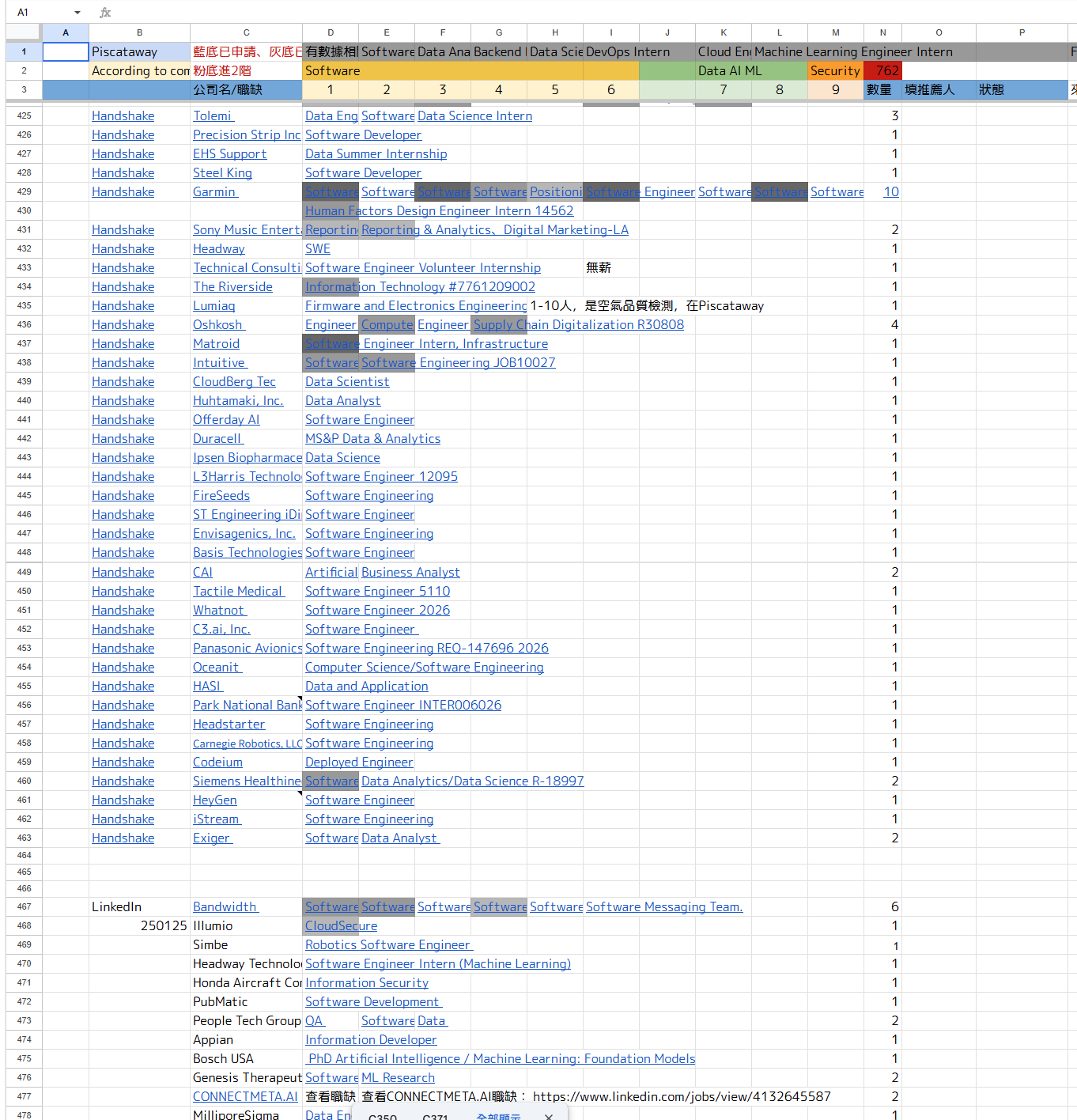 A snapshot of my raw data collection process—analyzing over 760 applications across Handshake and LinkedIn.
4. Navigating Contradictory Advice (Go Talk to Real People)
Other than interviews, I tried getting insights online. But as my YouTube and search history filled up with tech career topics, I realized I couldn't really tell who the true insiders were, whether they could back up their claims, or if they even believed their own words. Observing patterns doesn't work when the platform's algorithm is pulling the strings. People endlessly argue over everything: what goes on top of your resume, whether you need a second major, if you should get a cloud certificate, or if you must contribute to open source. I just didn't know who to trust.
I realized way too late that in an in-person discussion, things get so much clearer and your curiosity can actually be addressed or extended.
Doubting answers from every online resource, I started gathering information by asking questions to literally whoever I could reach out to: professors, people I met at career fairs, family friends, friends of friends, career center advisors, and recruiters. The best experience was crashing GraphSummit while interning at AMD. There, I talked to Neo4j's field application engineers about their products' latest use cases and challenges, chatted with folks from Amazon, Adobe, and Uber, and heard cutting-edge visions from CEOs and CTOs. For the entrepreneurial side, I also went to some meetups.
It’s pretty hard to create personal relationships with these people, especially as an international college student. Yet, I’m happy to have that identity because it gives you a pass to be purely curious. Genuine curiosity about people’s lives is sometimes the key to turning them into friends and mentors. One person I randomly reached out to during my internship even agreed to be my career mentor!
But for the most helpful selection, I learned to seek out mentors who were exactly one step ahead of me. For me, those are the junior engineers. They tell me their reasoning and tricks, and they’re truly the most helpful because they understand my exact challenges and just went through that same path.
As long as you are polite and audacious enough not to fear rejection, people are incredibly generous with their guidance.
5. Time Management as a Survival Tool
Navigating the job market, stressing over Taiwan's mandatory military service, and mapping out my academics was psychologically exhausting. I turned to the book Make Time and the Getting Things Done (GTD) methodology.
During my internship at AMD, while everyone else was out celebrating the 4th of July, I stayed in my room building my personal productivity system. People thought I was crazy, but I needed a way out of the anxiety. By offloading my chores into a GTD system and protecting my daily "Highlight," my mind became like still water, giving me the mental clarity to execute my next moves.
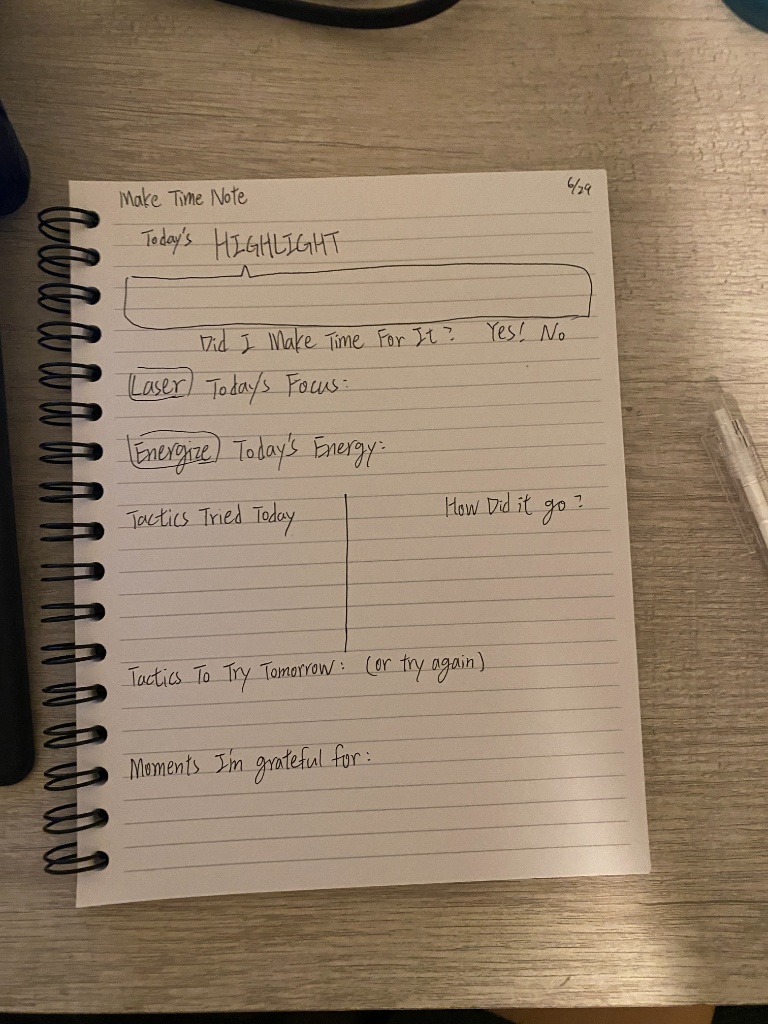 My daily Make Time and GTD analog setup to protect my highlight and maintain sanity.
Why I’m Sharing This With You
Looking back, the journey of constantly tweaking these specific mindsets and techniques has been genuinely fascinating. That crucial decision to transfer schools didn't just change my environment; it became the engine that kept pushing me forward.
Whenever people ask me why I made those unconventional choices, how I actually executed them, and what the results were, I always find myself wanting to pour out everything I’ve learned along the way. Universities are just mechanisms, and rather than passively waiting for a system to hand me credentials, I learned that I had to take ownership and build my value from the ground up.
So, I’m sharing this with you here—whether you are a hiring manager evaluating my potential, a peer in the trenches, or just someone I know.
Honestly, I’m still iterating on this unconventional path every day. If you are looking to hire and think my mindset and approach would be a good fit for your team, I’d love to explore opportunities to work together. Or, if you just want to discuss tech, bounce some ideas around, or check out the other topics I write about here on my blog, my inbox is always open. Just shoot me an email at AaronWu.official@gmail.com — I’d love to chat!